Study: Where you live doesn't affect access to surgical care for pediatric renal tumors

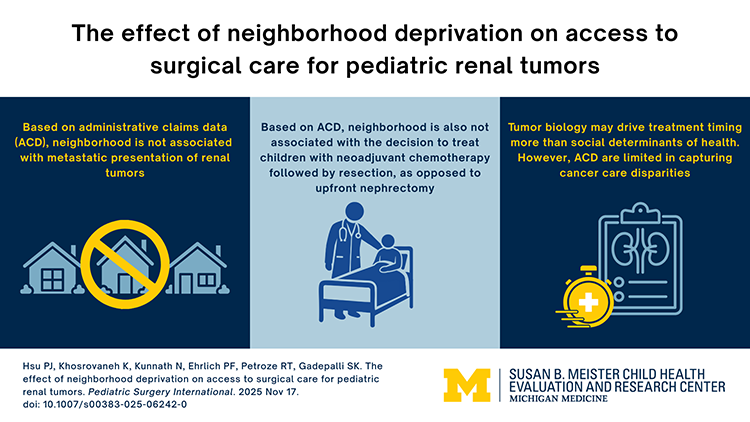
A multi-state study suggests that where a child lives, and the level of social and economic opportunity in their neighborhood, may not significantly influence whether pediatric kidney tumors are diagnosed at an advanced stage or how quickly surgery is performed.
Authored by CHEAR faculty investigator Samir Gadepalli, MD, MS, MBA, the study was recently published in Pediatric Surgery International.
According to Gadepalli, early identification of pediatric renal tumors is known to improve outcomes, and prior research has linked neighborhood deprivation — a composite measure of social determinants of health such as income, education, and access to resources — to worse cancer outcomes in some populations.
To better understand this relationship in childhood kidney cancers, the research team examined whether neighborhood deprivation affected the likelihood of metastatic disease at diagnosis or the timing of surgical treatment.
Using State Inpatient Databases (SID), investigators analyzed records of children admitted for nephrectomy due to renal tumors across 15 states between 2013 and 2021. Neighborhood deprivation was assessed using the Child Opportunity Index (COI) 3.0, a nationally recognized measure of neighborhood conditions relevant to child health and development.
The study included 1,574 children. Among them, 14.2% presented with metastatic disease at diagnosis, and nearly one in four (23.3%) underwent delayed nephrectomy —surgery performed after a course of neoadjuvant chemotherapy rather than upfront removal of the kidney.
The analysis found that children who presented with metastases or required delayed nephrectomy were more likely to be older and to have more complex chronic medical conditions. However, after adjusting for these and other factors, neighborhood deprivation was not significantly associated with either metastatic presentation or the timing of nephrectomy.
"We actually expected to find neighborhood deprivation as an effect because that tends to be the more common finding," Gadepalli said. "And so we looked at it a few different ways, and we tried a few different deprivation scales, but we found that it really didn't matter what we used. It really was the biology of disease that seems to dictate what you end up having done."
At the same time, Gadepalli cautioned that administrative databases such as SID have inherent limitations. While they are valuable for studying large populations, they may lack clinical detail needed to fully capture the nuances of pediatric cancer diagnosis, staging, and decision-making.