
Hospitalization associated with disruption of insurance for children
A child's hospitalization can be a stressful and disruptive experience for families — not only medically, but financially and logistically. New research suggests that these disruptions may extend to something as critical as health insurance coverage.
Using data from the MarketScan Commercial Database, a research team led by CHEAR faculty investigator Erin Carlton, MD, MSc, examined whether a child’s hospitalization is associated with interruptions in insurance coverage among privately insured families. The study, published in Hospital Pediatrics, included more than 219,000 hospitalized children, each matched to similar non-hospitalized children, along with over 1.5 million caregivers. Investigators tracked whether families experienced a lapse or disruption in insurance coverage within six months following a hospital stay.
“We wanted to understand whether children who experience hospitalization and their caregivers were at higher risk of disruption in their insurance coverage, compared to children who were not hospitalized," Carlton said.
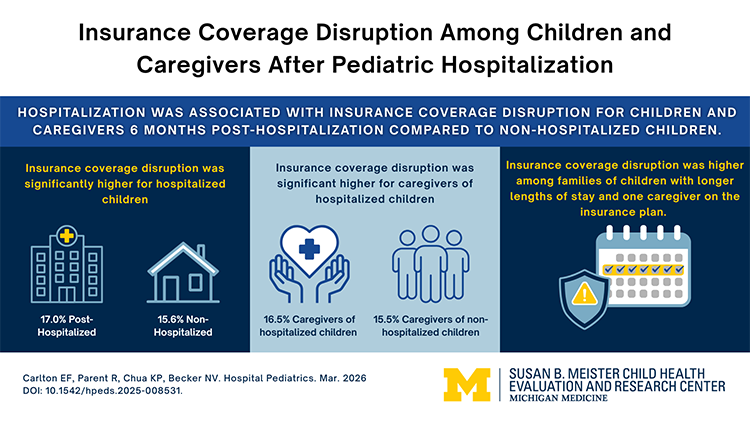
The findings showed a small but statistically significant increase in coverage disruptions among families of hospitalized children. About 17% of hospitalized children experienced a disruption, compared to 15.6% of non-hospitalized children — an increase of 1.3 percentage points. A similar pattern was seen among caregivers, with disruption rates of 16.5% versus 15.5%. While these differences may appear modest, they represent meaningful risks when applied across large populations.
Certain groups were more vulnerable. Families of children with longer hospital stays faced higher risks of losing coverage, as did households with only one insured caregiver. These findings suggest that hospitalization — often an already challenging event — may trigger broader instability in a family’s access to insurance.
“It may be important to assess for the stability of insurance coverage prior to a child’s discharge, especially among those groups who had higher risk of insurance disruption," Carlton said.